
Home »
Exploring Prehistory
Description
(Stone Age to Iron Age)
What was it like to live in prehistoric times and how do we know?
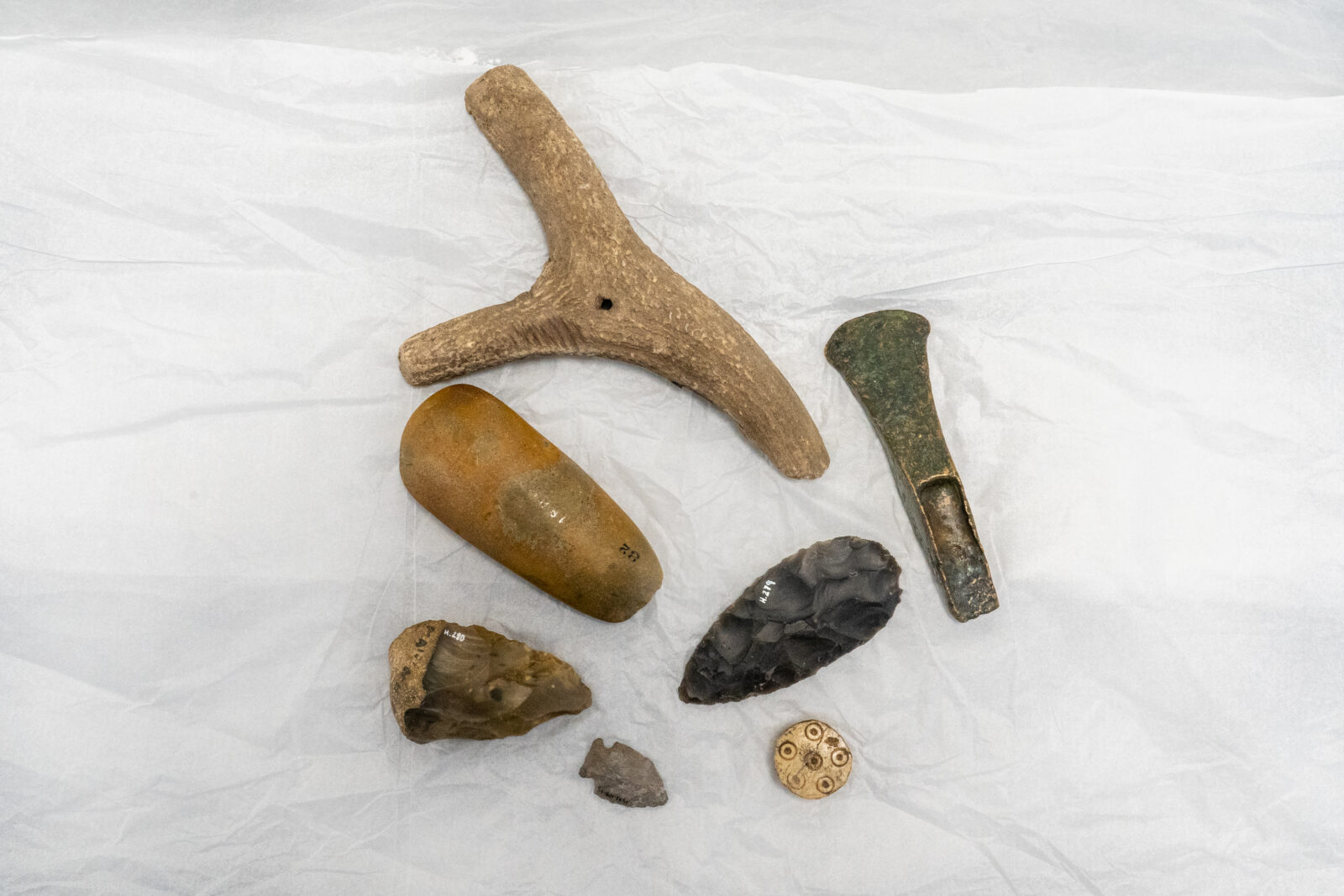
This hands-on, interactive workshop explores the chronology and key characteristics of the different periods of prehistoric Britain, and through investigation of real and replica artefacts from our collections pupils will understand how life changed for people in the Stone, Bronze and Iron Ages.
Participants will have the opportunity to:
- Develop an interactive timeline, putting into context the vast period of time and identifying key events, chronology and characteristics of the Stone, Bronze and Iron Ages.
- Act as archaeologists, examining collections of archaeological artefacts to determine their age and purpose.
- Handle and investigate real and replica artefacts from a mammoth tusk to the Desborough Iron Age mirror to build their knowledge of prehistory and how artefacts help inform us about the past.
Visit location
Northampton Museum and Art Gallery
Appropriate for
Key stage 2 (KS2)
Focus
History, Science, Art, Design and Technology
Session length
1 hour to 1 hour 15 minutes
Session capacity
35 children plus supervising adults
National Curriculum (NC) links
History
- changes in Britain from the Stone Age to the Iron Age
- know and understand the history of these islands as a coherent, chronological narrative, from the earliest times to the present day: how people’s lives have shaped this nation and how Britain has influenced and been influenced by the wider world
- know and understand significant aspects of the history of the wider world
- understand historical concepts such as continuity and change, cause and consequence, similarity, difference and significance, and use them to make connections, draw contrasts, analyse trends,
- understand the methods of historical (archaeological) enquiry, including how evidence is used rigorously to make historical claims, and discern how and why contrasting arguments and interpretations of the past have been constructed
Science
- Identify and name a variety of everyday materials
- Describe the simple physical properties of a variety of everyday materials
- Identify & compare the suitability of a variety of everyday materials, for particular uses
- Consider Properties and Changes of Materials
- Notice patterns, group and classify things
Design and Technology
- Investigate and analyse a range of existing products
- Understand how key events and individuals in design and technology have helped shape the world
Art
- Develop their techniques … with creativity, experimentation and an increasing awareness of different kinds of art, craft and design
Supervision
We ask schools to follow NSPCC guidelines as outlined in our terms and conditions.
Resources
Extension – to extend your visit you may wish to explore our history galleries with their displays on Northampton’s prehistoric past from stone age flint tools to iron working at Hunsbury hillfort. Entry to the museum is free of charge and you are welcome to spend as much time as you wish exploring the different galleries. Suggestions for pre, gallery and post-visit activities are provided to schools on booking the facilitated workshop.
Extension – we also offer a hands-on workshop for pupils to investigate prehistoric art and to make their own artworks / artefacts to take home with them – schools can choose to focus on Stone Age cave painting, Bronze Age beakers or Iron Age mirror making. This workshop is approx. 1 hour in length and is charged at £100 as an addition to the Exploring Prehistory workshop. If you are interested in booking this extension workshop, please note this in the special requirements box and indicate which period you wish to focus on.
Don’t forget we provide space to eat lunch free of charge for all schools booking facilitated workshops.
Cost
150 (Extension Art Workshop charged at £100)
Accessibility
Our sessions can be adapted to make them accessible for your students.